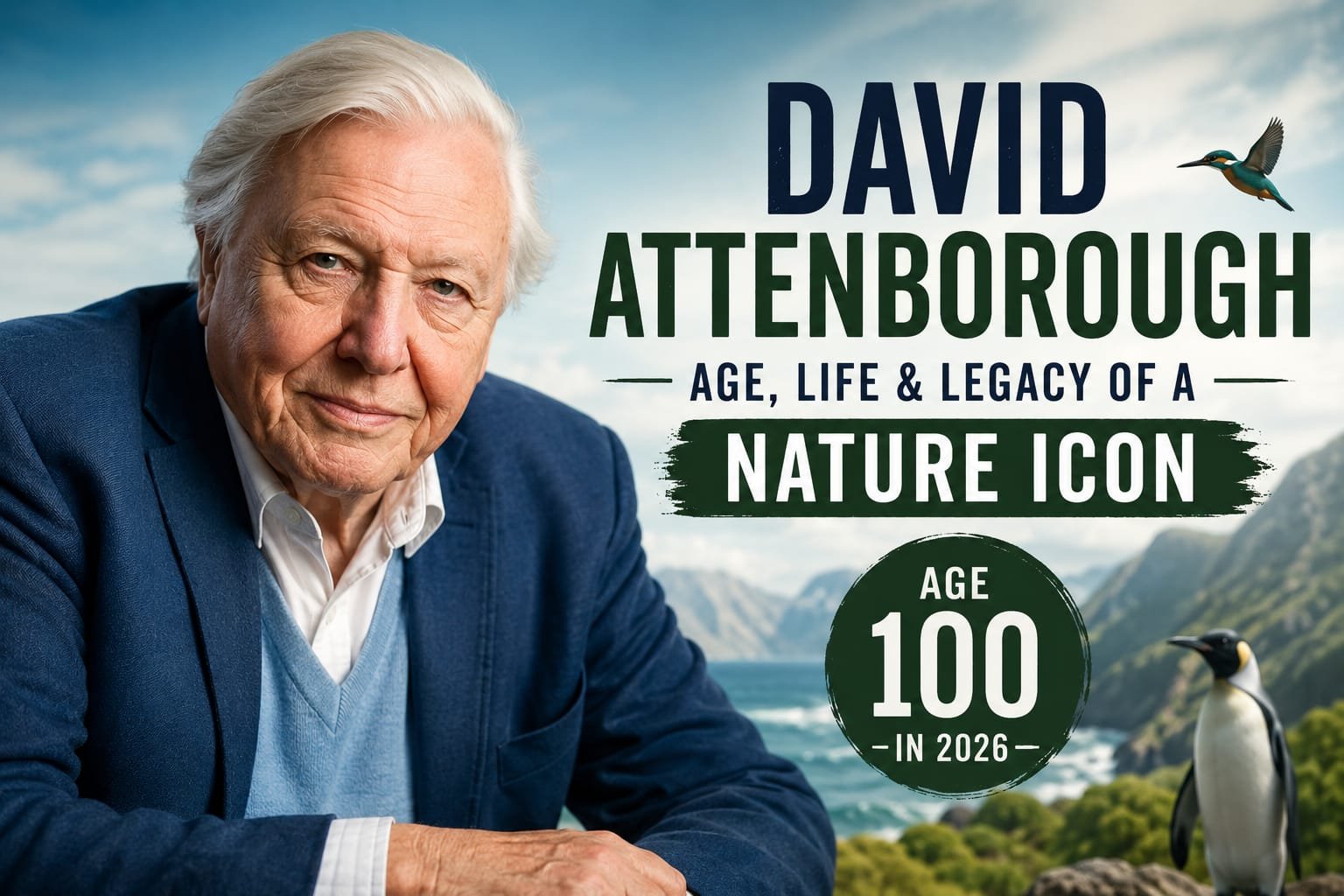
Few public figures have remained as admired and influential across multiple generations as David Attenborough. Known for his iconic wildlife documentaries, calm narration, and lifelong dedication to conservation, Attenborough has spent decades bringing the natural world into millions of homes.
One of the most searched questions about him today is simple: how old is David Attenborough age? The answer highlights not only a remarkable lifespan but also an extraordinary career that continues to inspire audiences around the world. From groundbreaking BBC productions to global environmental advocacy, his story is closely tied to the history of modern nature broadcasting itself.
Who Is David Attenborough? A Short Biography
| Detail | Information |
|---|---|
| Full Name | David Frederick Attenborough |
| Date of Birth | 8 May 1926 |
| Age | 100 years old (as of May 2026) |
| Birthplace | Isleworth, Middlesex, England |
| Nationality | British |
| Profession | Broadcaster, Natural Historian, Writer, Conservationist |
| Years Active | 1951–Present |
| Education | Clare College, Cambridge |
| Famous For | Nature documentaries, Planet Earth, Blue Planet, Life Series |
| Father | Frederick Attenborough |
| Mother | Mary Clegg Attenborough |
| Siblings | Richard Attenborough, John Attenborough |
| Marital Status | Widowed |
| Spouse | Jane Elizabeth Ebsworth Oriel (m. 1950–1997) |
| Children | 2 |
| Source of Income | Television, Documentary Production, Books, Public Speaking |
How Old Is David Attenborough?
David Attenborough was born on 8 May 1926. As of 2026, he is 100 years old. His centenary birthday was celebrated across the United Kingdom and internationally, marking a milestone rarely reached by someone who remains so active in public life. (Wikipedia)
Reaching 100 years of age is remarkable on its own. What makes Attenborough’s story even more extraordinary is that he continues to work on documentaries, environmental projects, and public awareness campaigns. His voice remains instantly recognizable to audiences who have followed his work for decades. (opb)
Why His Age Fascinates So Many People
Many celebrities become known for a single era of entertainment. Attenborough’s career has spanned more than seventy years, allowing multiple generations to grow up watching his programs.
He was born before television became a household technology, witnessed the rise of color broadcasting, helped shape modern television, and later embraced advanced filming techniques including 4K and high-definition wildlife cinematography. His life effectively mirrors the evolution of modern media. (Wikipedia)
Celebrating His 100th Birthday
Attenborough’s 100th birthday became a major cultural event in Britain. Tributes arrived from scientists, environmentalists, broadcasters, world leaders, and members of the British royal family. Special BBC programming and celebrations highlighted his contributions to education, conservation, and television history. (Wikipedia)
The milestone also sparked renewed appreciation for the influence he has had on public understanding of wildlife and climate issues over the last century. (gk365.in)
David Attenborough’s Early Life and Childhood
Growing Up With a Passion for Nature
Attenborough’s fascination with the natural world began at an early age. As a child, he collected fossils, stones, and animal specimens, spending hours exploring and learning about wildlife.
Stories from his youth reveal a deep curiosity about nature that would later define his career. One famous account notes that he supplied newts to a university zoology department while still a schoolboy. These early experiences helped shape his lifelong passion for biological sciences. (Wikipedia)
Education at Cambridge
After completing his schooling, Attenborough studied natural sciences at Clare College, Cambridge. His academic training provided a strong scientific foundation that later distinguished his broadcasting work from traditional television presenting.
Rather than simply entertaining audiences, he developed a reputation for explaining complex ecological concepts in a way that felt accessible and engaging. This balance between science and storytelling became a hallmark of his documentaries. (Encyclopedia Britannica)
Military Service and Career Beginnings
Following university, Attenborough served in the Royal Navy before beginning his professional career. He initially worked in educational publishing but soon found his way to the BBC.
Although he had little television experience at the time, his knowledge, curiosity, and communication skills quickly made him a valuable part of the organization. (Wikipedia)
The Career That Made David Attenborough a Global Icon
The Success of Zoo Quest
Attenborough’s rise to public recognition began with Zoo Quest, a wildlife television series first broadcast in the 1950s. Unlike many programs of that era, it focused on animals in their natural habitats rather than simply displaying them in captivity.
The show’s adventurous format introduced viewers to remote locations and exotic wildlife, helping establish Attenborough as one of television’s most compelling presenters. (Wikipedia)
The Landmark Life Series
His reputation expanded dramatically with the release of the acclaimed Life series, beginning with Life on Earth in 1979.
These documentaries transformed nature broadcasting by combining scientific accuracy with cinematic storytelling. Viewers could experience everything from rainforest ecosystems to deep-ocean environments through Attenborough’s narration and expertise. The series became influential worldwide and remains a benchmark for wildlife filmmaking. (Encyclopedia Britannica)
Planet Earth and Modern Documentary Excellence
New generations discovered Attenborough through productions such as Planet Earth, Blue Planet, Frozen Planet, and their sequels.
Advances in camera technology allowed filmmakers to capture animal behavior with unprecedented detail. Attenborough’s narration added context and emotional depth, turning these documentaries into global successes. His work helped redefine how audiences engage with environmental issues and biodiversity. (Wikipedia)
How David Attenborough Changed Conservation Awareness
Bringing Environmental Issues Into Mainstream Media
While Attenborough has always celebrated the beauty of nature, his later work increasingly focused on environmental challenges. Habitat destruction, climate change, pollution, and species loss became recurring themes in his documentaries.
Rather than relying on alarmism, he often combines scientific evidence with powerful visual storytelling. This approach has helped make environmental conversations more accessible to global audiences. (gk365.in)
Inspiring Future Generations
Scientists, filmmakers, conservationists, and educators frequently cite Attenborough as a major influence. His ability to communicate wonder and urgency simultaneously has encouraged countless people to pursue careers related to wildlife and environmental science.
Many younger viewers first developed an interest in nature through his documentaries, demonstrating the lasting educational impact of his work.
Recognition and Awards
Throughout his career, Attenborough has received numerous honors, including BAFTA Awards, Emmy Awards, and knighthoods. He is also notable for winning BAFTAs across multiple generations of broadcasting technology, from black-and-white television to modern 4K production. (Wikipedia)
His influence extends beyond television, with numerous animal and plant species named in his honor as recognition of his contributions to natural history and conservation. (gk365.in)
David Attenborough’s Legacy at Age 100
Still Active After Seven Decades
One reason people continue searching for David Attenborough’s age is that his energy and professional involvement remain impressive. Even after entering his centenary year, he continues participating in documentaries and environmental initiatives. (gk365.in)
His continued presence demonstrates an enduring commitment to educating audiences about the natural world rather than simply resting on past achievements.
A Voice Recognized Around the World
For many viewers, Attenborough’s voice has become inseparable from wildlife storytelling. His narration style combines authority, curiosity, and genuine enthusiasm, making scientific subjects approachable without oversimplifying them.
That unique ability has helped him maintain relevance across generations, from viewers who watched Zoo Quest in the 1950s to those streaming Planet Earth today.
An Enduring Cultural Figure
Attenborough’s legacy reaches far beyond television. He is widely regarded as one of the most trusted communicators in environmental education, and his work continues influencing discussions about biodiversity and climate responsibility.
At age 100, he remains a symbol of lifelong curiosity, learning, and dedication to understanding the natural world. (Scientific American)
Frequently Asked Questions
Q: What is David Attenborough’s age in 2026?
A: David Attenborough is 100 years old in 2026. He was born on 8 May 1926 and celebrated his centenary birthday in May 2026 with tributes and events held across the United Kingdom and beyond. (Wikipedia)
Q: When was David Attenborough born?
A: David Attenborough was born on 8 May 1926 in Isleworth, Middlesex, England. His early fascination with wildlife and natural history eventually led to one of the most influential broadcasting careers in television history. (Wikipedia)
Q: Is David Attenborough still working?
A: Yes. Even at 100 years old, Attenborough remains involved in documentary projects and environmental advocacy. His recent work continues to focus on wildlife conservation, climate awareness, and public education. (gk365.in)
Q: What is David Attenborough most famous for?
A: He is best known for presenting and narrating landmark wildlife documentaries, including Life on Earth, Planet Earth, Blue Planet, and Frozen Planet. These productions have shaped modern nature broadcasting and inspired audiences worldwide. (Wikipedia)
Q: Why is David Attenborough considered important?
A: Attenborough helped transform wildlife filmmaking and environmental communication. Through decades of documentaries, he introduced millions of people to the natural world while raising awareness about conservation and climate challenges.
Final Thoughts
David Attenborough’s age is more than a number. At 100 years old, he represents a century of discovery, education, and storytelling that has changed how people view the natural world. From his childhood fascination with fossils to his status as one of the world’s most respected broadcasters, his journey is remarkable in both length and impact.
His documentaries continue to inspire curiosity about wildlife while encouraging greater responsibility toward the planet. As new generations discover his work, Attenborough’s legacy remains as powerful as ever, proving that a lifelong passion for learning can leave an enduring mark on the world.



[…] on October 9, 1998, Gavin Adcock age is 27 years old as of 2026. His journey from a cattle farm in Georgia to sold-out concert venues has […]